



Rich Future is a newsletter about the future of work and money, written by a CPA. By day, I advise startups on finance strategy. By weekend, I write for builders and investors who want foresight on opportunities before they’re priced in. If you were forwarded this post, you can subscribe here.
I drank the Kool-Aid. I pivoted away from a successful business last year to bet on an AI narrative I’m now questioning. While I still believe AI is transformative, I now realize the distance between what it can do today and what the AI hype narrative says it will do tomorrow is a gap being exploited by companies with a financial interest to close it faster than reality suggests.
This is the graph that clarified things for me.
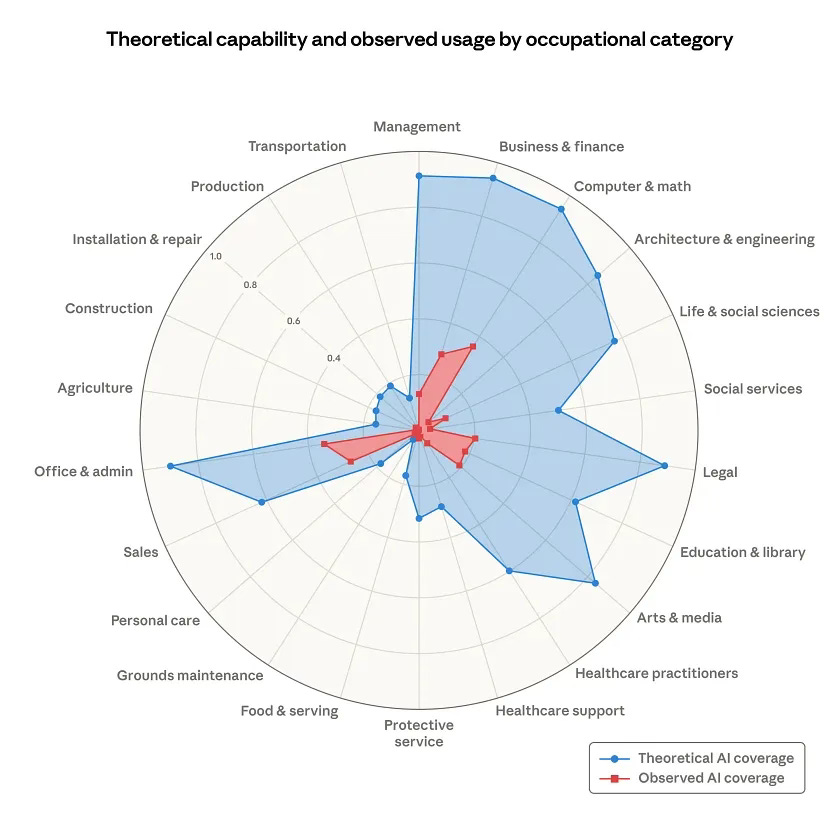
It was published by Anthropic this week in their latest labor market impact report. Anthropic makes Claude. Claude is an LLM. I use Claude daily. Steven Bartlett shared the same graphic to his millions of LinkedIn followers and it’s already one of his highest engaged posts of 2026 which tells us just how frothy the hype is surrounding the “AI will replace jobs” narrative right now.

In his post, he muses that we’re at maybe 5% of where this technology could be deployed in the job market and ended with a thought about AI giving us permission to be fully human again.
I like Steven. I admire him as a media entrepreneur. I’ve also spent years looking at charts like these in company pitch decks. This graph is a total addressable market (TAM) slide. It’s important we see that for exactly what it is… a marketing tool. Anthropic sells AI tools and is publishing research about how much more of its product the economy could potentially buy. Buyers being both enterprise and consumer. Anthropic’s own reporting highlights computer programming work as the most exposed occupation with 75% automation coverage.
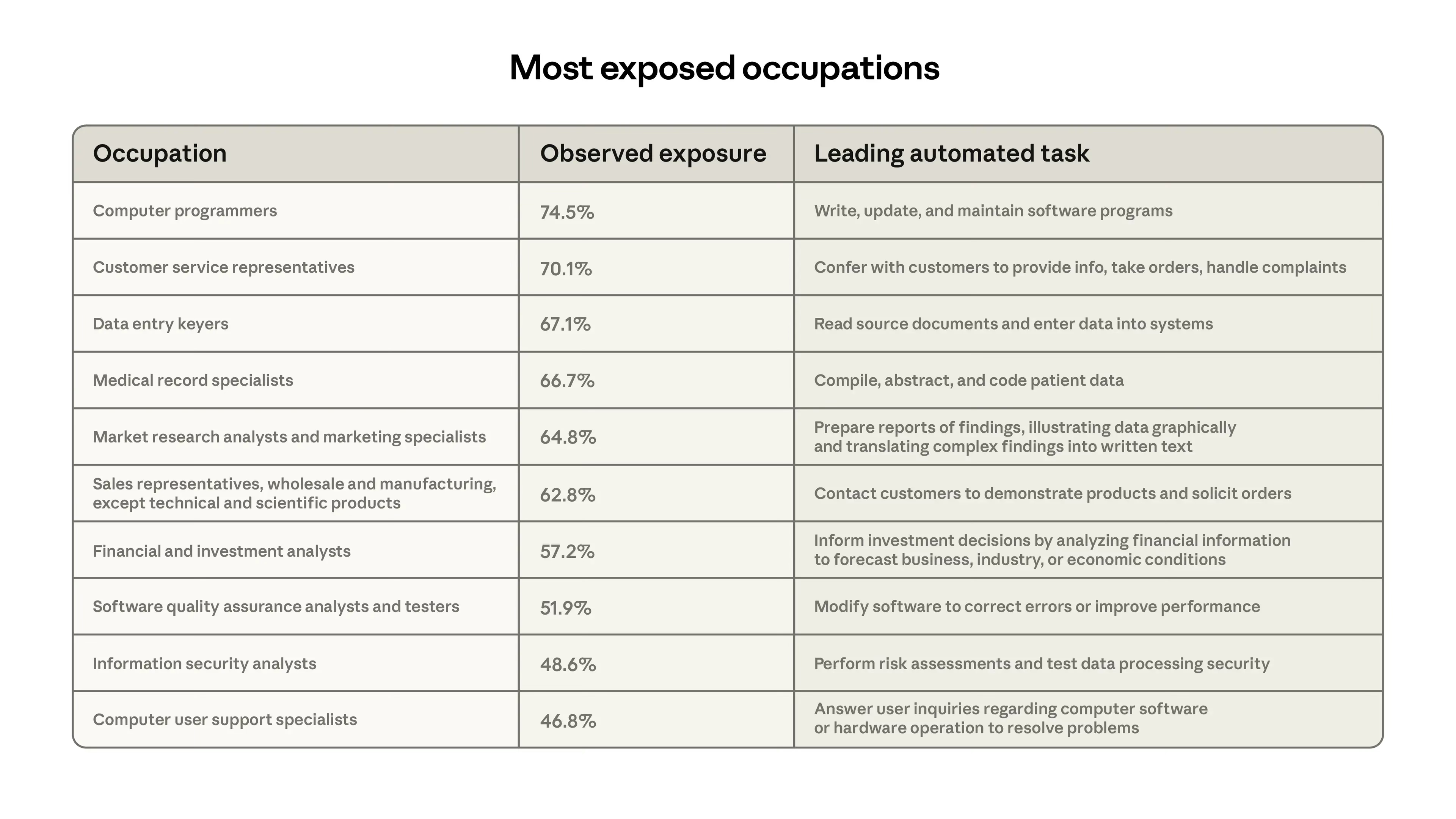
Meanwhile, their careers page has 120+ open engineering roles. So either Anthropic is hiring people into roles they plan to automate or something else is going on. This is one of the most resourced AI companies on the planet. They supply technology to the Pentagon. If anyone can replace engineering work with AI, surely it's Anthropic?
So then I got to thinking about how much merit there is to the blue parts of the graph. It maps what LLMs could theoretically replace, which includes 94% of Business & Finance activities. Right… so it assumes the economy remains static while automation rolls over it. Their model doesn’t account for the roles that haven't been invented yet because it's measuring today's tasks against today's jobs. New technology creates new problems. New problems create new work. Anthropic itself didn't exist five years ago. Now it needs 120 engineers. Plus, every company of every size is going to need people to manage the AI outputs that were supposed to replace the people.

Meanwhile…
On February 26th, Block laid off 40% of its 10,000 person workforce, despite gross profit being up 24% YoY. The company CEO, Jack Dorsey, cited AI as the reason for layoffs, “we're already seeing that the intelligence tools we’re creating and using, paired with smaller and flatter teams, are enabling a new way of working which fundamentally changes what it means to build and run a company. and that's accelerating rapidly.”
The stock jumped 17%.

I saw Jack’s announcement and chose not to write about it last week because my gut sense was there was something more to the story. Turns out that was true. A few days later, Naoko Takeda, a data scientist at Block and part of the 60% who survived the cuts, quit publicly. She said the company had been aggressively pushing employees to adopt AI tools internally for months. Despite that push, Naoko felt the productivity gains were minimal, “Personally, I saw very limited gains in productivity from AI, nothing nearly profound enough to justify tossing out half of the company's workforce along with their institutional knowledge and expertise.”
From there, Bloomberg raised the question of AI-washing, which refers to a company’s use of AI as the public justification for a decision that's actually driven by something more mundane like cost cutting or an over-hiring correction. Then, Block's former Head of Communications published a guest essay in the New York Times, confessing that the AI job cuts aren’t what they seem. Upon analysis of the roles that were cut (the policy team, DEI) it looks more like typical cost management with an AI-maxxing headline. Even Sam Altman said some companies are using AI as cover for layoffs unrelated to the technology, that they want to make anyway.
This situation is clearly not unique to Block.
The fact that their stock jumped 17% means that public company CEOs are now incentivized to reduce headcount and package it as innovation. While this is happening, Whoop’s CEO, Will Ahmed, announced this week that his company is nearly doubling its workforce. His take is that investing in talent and investing in AI are not mutually exclusive. I agree with him. It’s interesting how small the amplification of hiring announcements are compared to the layoffs. The pain for 4,000 people is real. But the story being told about why is doing more work for Block’s stock price than for the truth.
The reason the AI hype marketing play is so effective is because it pushes on two of the deepest human pain points… the fear that we’re replaceable and the fear of income loss. Press pain points. Sell solution… which is a pretty standard business model. We need to stop engaging with it like it's prophecy.
It’s time to start asking better questions like, “Who published this? What do they sell? What am I being primed to believe?”
AI hype has peaked.
To be clear, I’m not saying AI itself has peaked. Robotics and world models are coming in behind the LLM wave and will be genuinely transformative. But the hype… yeah. She peaked. I think the next few months are going to be uncomfortable for many people I respect as they reconcile hype with data. It’s certainly been an eye-opening week for me. I drank the Kool-Aid. Now I need something for the stomach ache.
A few other things on my radar this week...

Scientists put 200,000 human brain cells on a chip and taught them to play Doom. Welcome to biological computing.
Replit CEO suggests being “brainrotted” & “terminally online” is an advantage in the AI age. Replit sells AI coding software.
How many AI tools is too many? Harvard thinks the answer is 4.
Les Mills surveyed 10K+ consumers across five continents and found only 10% prefer AI-led workouts. The majority prefer human for expertise and community.
Partner with Rich Future
For brand partnerships, email us at hello@richfuturemedia.com
Epic post Kalei!