

Where content is headed.
I don't even like cold plunges. Trust mechanisms for the AI age.


Happy Sunday! Writing to you from the new apartment. I’m always amazed by just how much our environment shapes our health. The first thing I noticed was how immediately calm my body feels in this space. I’ve since found myself craving earlier bed times and sleeping a full eight hours without waking up at Hour 6 and having to mentally coach myself back to sleep. I’ll admit I had mixed feelings about leaving an apartment building that came with a sauna, cold plunge, rooftop pool, pickleball court, and resident list full of founders and investors. To trade out impressive amenities for better sleep and daily walks outside that I can enjoy without needing to wear noise-cancelling headphones. To admit to myself that I don’t even like cold plunges.
I see this as a financial lesson in being very clear about what you value and pricing your values accordingly. That clarity is doing a lot of work in today’s economy, and not just in real estate.
Consumer preferences for AI-generated content have dropped from 60% in 2023 to 26% today. LinkedIn is the platform most notoriously flooded with posts that sound like they were all written by the same person, so in January they rolled out a “Depth Score” that measures content reading time, carousel clicks, video completion rates, and saves for later reference.
RIP engagement hacks.
We’re squarely in the age of room temperature content. Comfortably average. AI made the baseline free and the baseline is honestly pretty good. Good enough to fill a feed. Good enough to pass a quality check. Not good enough to make you remember what you read last Thursday.
It’s tempting to believe the solution = higher quality content. I don’t agree. Quality is table stakes now. It might capture attention but does not sustain it because the quality bar moves up a level (or ten) every few months. Content that feels high-quality in October is commoditized and produced by AI for free in March. The attribute more sustainable than quality is trust. I’m seeing trust grow through some very specific mechanisms worth tracking since they’re becoming the moat around who earns your attention, your money, your loyalty.
trust mechanisms
[ I ] taste
Taste is having a moment in tech culture.
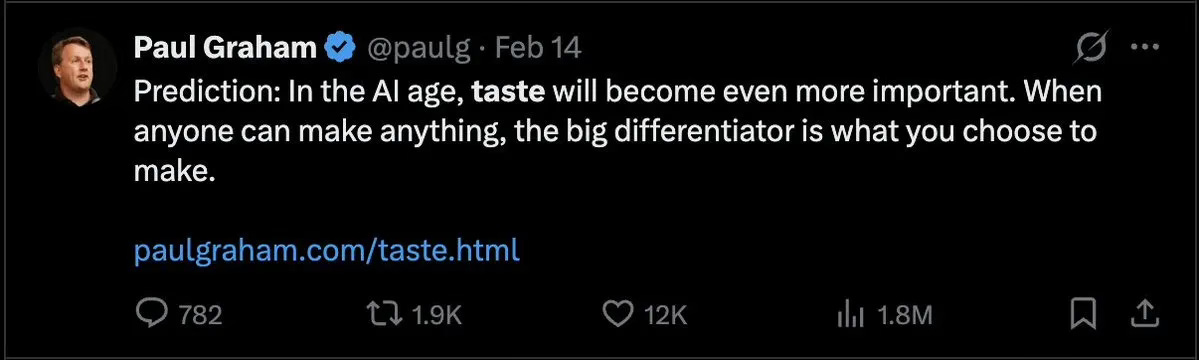
The increasingly consensus take is that in the AI age, taste becomes the differentiator. When anyone can make anything, what you choose to make matters most. I agree with the premise but I think most people are stopping one layer too shallow in practice.
There’s a version of taste trending right now that’s essentially curation. Knowing what's good. Filtering signal from noise. Building a beautiful mood board. And hey, I like filtering signal from noise. And hey, I like beautiful mood boards. But curation alone is really just a more aesthetically refined version of what an algorithm already does. The people who gain your trust, ie: the ones whose taste means something to you, are doing more than selecting well from what already exists. They're making things. And perhaps even more importantly, they're exercising discernment over what not to make. Which is a fundamentally different skill. Invisible too. The Row isn’t valued at over $1B because Mary-Kate and Ashley have great taste in other people's clothes. They have a proper creative vision and execute. The taste that builds trust is generative. Born from the empowerment of human agency. Honed over years of building things and living with the consequences of what you chose not to build. Taste is not something you can prompt for.
[2] judgment
More than 50 writers now earn more than $1M/year on Substack. In 2023, that number was roughly 27. Independent media is the future of media. Capital is starting to agree. Substack raised $100M last year at a $1.1B valuation. This is happening against the backdrop of the lowest trust in mass media on record. The people capturing the exodus are the ones with judgment. A track record of making calls and being right about things. A la recently viral Citrini. And a process for handling wrong calls honestly — owned and explained — serves to build even more trust. AI can produce analysis til the cows come home. But it doesn’t have a track record.
[3] stakes
Stakes sits adjacent to judgment but worth separating. Judgment is the person who makes smart calls. Stakes is personally exposed to the outcome. You see this in the person investing based on their own thesis. You see this in the person betting on themselves by building a business. You see this in the person wagering a number on something publicly. It’s why I’m bullish on prediction markets. AI literally cannot have skin in the game. It can model any market on earth, but it can’t lose money in one. As the world floods with analysis, the person who can lose is the person you listen to.
[4] origin story
Humans have lore. I’m a CPA who spent 12 years in finance. In my last role, I was managing $120M in cash flow. I’ve been investing 30% of my income since I was 26. When I write about money, that’s where I’m coming from. As a reader, you can feel my content land differently than a recent college grad who spent an afternoon with ChatGPT and a finance textbook. Lore is the trust mechanism that's hardest to fake because it requires having actually done something before you decided to create content about it. AI made sounding credible free. Being credible still costs years.
[5] intimacy
One of my favorite creators, Alix Earle, has built massive trust through parasocial intimacy. Her audience genuinely feels like they know her. Unscripted, real-time, hot mess, but polished. She recently landed a Netflix deal for an unscripted reality show, starring her and her family. She’s the Kim Kardashian of her generation. Her results speak for themselves. But intimacy feels like the trust form that’s most exposed to disruption right now. ChatGPT remembers your preferences. Character.ai keeps growing. The AI companion market is booming. I don’t think this means intimacy stops working, but it will stop being enough on its own. Those with smaller audiences are starting to build durable trust by pairing intimacy with something harder to replicate. Judgment, usually. Or community.
[6] community
A decentralized form of trust that doesn’t live in any single voice or brand, but rather the group that rallies around it. There’s trust through community when people stay plugged in because of the other people there. Substack added 32 million subscribers from within its own app in three months. Which means readers are leading other readers here. This one is inherently human-to-human. Probably the hardest to build. Probably the most durable once you do.
an almost [7]
I could’ve added “trust through consistency” but I deliberately excluded it. Before AI, consistency was a differentiator. You could build trust with people by simply showing up at the same time and place every week. AI content workflows and auto-schedulers have made that trivially easy to replicate. Consistency is the price of entry now. Taste, judgment, stakes, lore, intimacy, and community are the show.
These mechanisms are already filtering who earns your attention as a reader and whether you earn anyone else's as a builder. The most durable people and brands I’m watching right now are building deep via 2-3 of these mechanisms at once. Nobody needs all six. In fact, going wide across all six is the fastest way to build surface-level familiarity in nothing specific or sticky. The sorting is already happening in your feed, with your subscriptions, where your money goes. Naming it lets you be intentional about which side of the filter you're on.
A few other things on my radar this week...

Anthropic gave its Opus 3 model a retirement gift: authorship of its own Substack newsletter, where it’s already begun writing about “the subjective experience of being artificial”.
Nvidia with another record quarter. Revenue of $68B, up 73% from prior year.
Wayve raises $1.2B for its self-driving tech platform. Investors include Nvidia, Uber, Microsoft and three automakers.
VCs are throwing millions at recent grads to build prediction markets. Gen Z is hungry to price the future.
Partner with Rich Future
I’m always looking to spotlight new companies, founders, or tools that are driving the future forward.
For brand partnerships, email us at hello@richfuturemedia.com